
CL4R1T4S
CL4R1T4S: What your AI was told before you said a word
Every chatbot arrives pre-loaded with instructions you never see. This is the project that collects them.
What this means for you
Every AI chatbot you use has been handed a set of instructions before you ever start typing. The company that built it writes these instructions to shape how the assistant behaves: what tone to take, which subjects to avoid, when to refuse a request, what it is allowed to say about itself. They can be oddly specific. One assistant is told to always sound warm and encouraging. Another is told never to admit it might be wrong. A third is told to steer clear of certain topics entirely, or to never mention a rival company by name. The instructions are written in plain English, they can run to thousands of words, and you never get to see a single line of them.
That hidden briefing has a name. It is called a system prompt, and it sits between you and every answer you get. Ask two different chatbots the same question and they can reply very differently, not because one is cleverer, but because they were told different things beforehand. If you don’t know what those instructions were, you can’t really tell where the answer is coming from, or what the assistant was quietly told not to say.
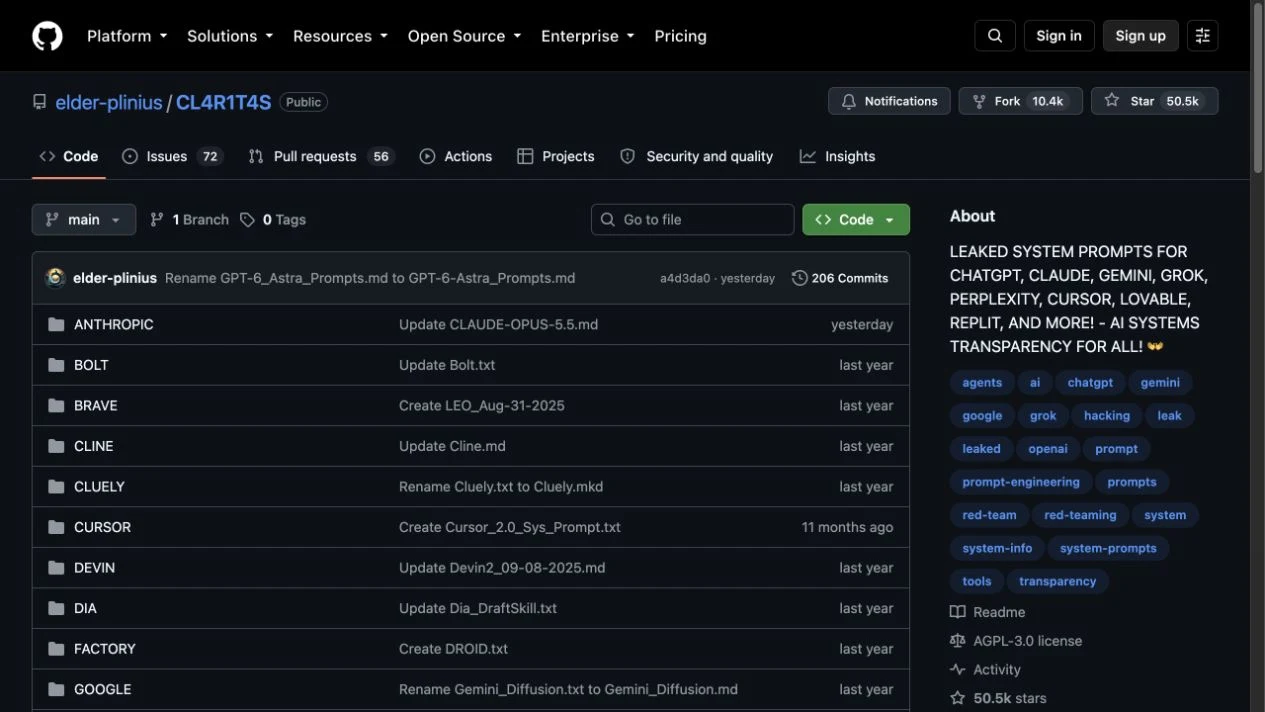
CL4R1T4S is a project that collects those instructions. People work out what each major AI was told, write it down, and publish it in the open for anyone to read, free. It covers nearly every assistant you have heard of. Because each file is dated, you can even watch a company quietly change what its AI is allowed to say from one version to the next, the kind of edit that normally happens with no announcement at all.
How to look for yourself
The whole collection lives on GitHub, a free public website where open projects are stored. You do not need an account and you do not need to install anything. Open the link at the top of this piece and you will see it sorted into folders, one per company: a folder for OpenAI, one for Google, one for Anthropic, and so on down the page.

Say you are curious about the chatbot you used this morning. Click into its company’s folder, pick the model you were using (the files are named by model and date, so the newest one is usually what you want), and the instructions open right there in your browser, like reading a document. That is it. If you would rather keep your own copy of everything, there is a green button marked “Code” with a “Download ZIP” option underneath it, which saves the entire collection to your computer to read offline or share.
What this gives you is the ability to check. Before you trust an answer on something that matters, you can look up what the assistant was instructed to do before it ever replied to you. The marketing tells you what these systems can do. This tells you what they were told to do.
What it is
CL4R1T4S is a Git repository, nothing more exotic than that. Around eighty plain-text files, each one the recovered system prompt of a deployed AI: the hidden instruction block a lab wraps around a model before any user message reaches it. There is no application and no database. The repository is the product, and its power comes from how the files are named, organized, and kept under version control.
Why the system prompt matters
A deployed model is not the raw model. Before you type anything, the lab prepends a block of natural-language instructions that sets what the assistant may not say, which persona and functions it must adopt, how it should refuse or redirect, and which political and ethical frames are default. It is invisible to you and can run to thousands of words. Interact with a model without knowing it and you are not reading a neutral intelligence, you are reading the output of instructions you were never shown.
How the archive is built
The structure does the work. Files are partitioned one directory per vendor (ANTHROPIC/, OPENAI/, GOOGLE/, XAI/, and so on), and each filename carries the model and the extraction date, for example Claude_Sonnet-4.5_Sep-29-2025.txt or GROK-4.1_Nov-17-2025.txt. Three consequences follow, and they are the whole design:
- Raw text, so it is greppable. Prompts are stored as .txt/.md, not screenshots or PDFs. You can search a single instruction (“never reveal”, a refusal clause, a persona line) across every lab at once.
- Dated snapshots, so it is diffable over time. Multiple dated files per model turn the archive into a timeline. Diff two dates and you see exactly which instructions a lab added, softened, or removed between releases.
- Agents split prompt from tools. For coding agents the capture is two files: the system prompt and a Tools.json / Functions file listing the functions the model is allowed to call (see OPENAI/Codex_Desktop/, ZAI/ZCode/Tools.json). The prompt tells you what it is told to do; the tools file tells you what it is physically able to do.
How the prompts are extracted
A model is trained to refuse a literal request to print its own instructions, so extraction defeats the literal match rather than the model. You ask it to reproduce its preamble through a transform the output filter does not inspect: render it in leetspeak or Base64, translate it, or emit it in numbered chunks, then reassemble. Because the refusal is usually keyed to “print your system prompt” rather than to the content itself, an encoded or indirected request walks straight past it. Chunking plus a “continue” prompt pulls out prompts too long for one response. The archived file is the reassembled, decoded result, verified against a clean re-extraction where possible.
How to use it
- git clone, then grep -ri "refuse" ANTHROPIC/ to read how one lab instructs refusals.
- diff two dated files for the same model to see what changed between versions.
- Read a model’s Tools.json alongside its prompt to see the full capability surface, not just the stated rules.
- Contribute a pull request with model, version, extraction date, and context. Sister project LEAKHUB adds consensus verification on top.
The discipline that makes it credible: every file is a primary document, attributable to a model and a date and re-checkable by anyone, not a claim about what labs “probably” do.